

Food waste collections
Weekly household food waste collections are being introduced in Adur and Worthing to help us to improve our recycling rate and to comply with the government's Simpler Recycling regulations, which aim to create greater consistency in the way recycling is collected across the country.
In Adur and Worthing, one third of the waste in our refuse bins is food waste. This waste will soon be separated and treated via anaerobic digestion, producing valuable biogas and fertiliser.
Plate scrapings, tea bags, banana peels - no matter how little food you waste, it's really important that it is recycled. Your food waste recycling bin will always be emptied no matter how little it contains.
You may have been looking for:
About your new food waste collections
Weekly food waste collections will start in stages from September 2026. We will let you know when your collections will start when we deliver your starter pack.
We are sending a letter to every household whose collections are due to start in September, so if you don't get a letter it means your household is in phase two and we'll be in touch with more information about your start in due course.
Your refuse and recycling collections will continue as usual every other week - these new food waste collections are an additional service.
Your bin collection day will not change, and your food waste recycling bin will be collected weekly on the same day as either your recycling or general waste bin. Bins should be placed out for collection by 6:30am.
You can receive reminder alerts for bin collection days by downloading our free app:
You can check your bin collection day by using our postcode search function to view the collection dates for your property:
How food waste is recycled
Once collected by one of our specially designed smaller collection vehicles, food waste from homes across Adur and Worthing will be transported, in bulk, to the Anaerobic Digestion Plant near Horsham, operated on behalf of West Sussex County Council.
At the plant, the waste will undergo anaerobic digestion, a process that converts waste into biofertiliser and renewable energy. The biofertiliser will be supplied to local farmers for use on their fields, while the energy generated will power the plant itself, with any surplus energy exported to the national grid to provide power for homes.
Watch our short video on what happens to your food waste after collection.
Your caddy and starter-pack delivery
We will let you know when your collections will start when we deliver your starter pack. If your household does not get a letter or starter pack in August it means your address is in phase two and we'll be in touch with more information about your start in due course.
No one needs to be home to take delivery of the starter pack. The pack will be delivered outside your property, or outside your door if you live in a flat.
If you live in a house:
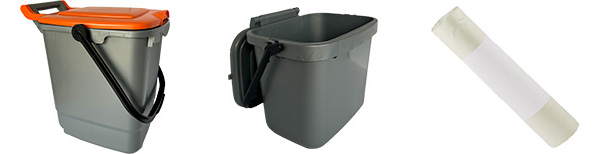
We will be delivering a starter pack to houses in phases from August 2026. This free pack includes:
- a 23-litre grey bin with an orange lockable lid
- a 5-litre internal kitchen caddy/bin
- an instructional leaflet
- a roll of liners to get you started
If you live in a flat:
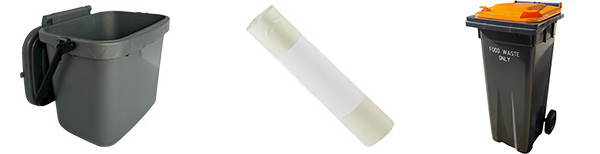
If you live in a flat you will receive:
- a 5-litre internal kitchen caddy
- an instructional leaflet
- a roll of liners to get you started
A 140-litre wheeled bin with an orange lid will be supplied to your bin store for you to empty your kitchen caddy contents into.
What you can (and can't) put in your food waste bin
Please remove all packaging and plastic from food waste before putting it into your food waste bin.
 These can go in your bin:
You can put cooked and uncooked food waste into your food waste bin, including:
- meat - including bones
- fish and shellfish
- dairy products such as cheese and yoghurt
- cooked and uncooked vegetables and fruit including peelings
- bread, cakes and pastries
- rice, pasta and beans
- plate scrapings
- tea bags and coffee grounds
- eggshells
- solid fats
- pet food
- mouldy and out-of-date food
 These can't go in your bin:
Do not put the following in your food waste bin:
- non-food products or materials, such as cutlery or takeaway boxes
- packaging of any sort, such as packaged ready-meals and plastic carrier bags
- oils and liquids
- animal waste and bedding
- flowers
- plastic bags:
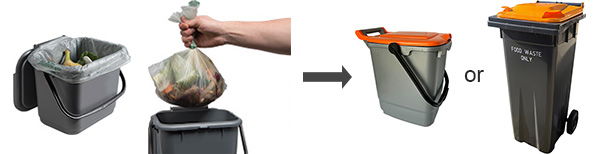
- please only use compostable liners, kitchen roll or newspaper to line your kitchen caddy.
- by avoiding plastic bags we can reduce the amount of microplastics entering the process, and increase the quality of the soil fertiliser.
 Please note:
- If you put items that can't be accepted into your food waste bin, it will not be emptied.
- Neighbouring councils have reported that some residents have mistakenly placed the small indoor caddy inside the outdoor bin for collection, and consequently the indoor caddies have been emptied into the vehicle.
- Please only empty your bagged or lined food waste into your outside bin.
FAQs - frequently asked questions
When will my food waste collections start?
Letters have been sent to every household whose collections are due to start in September. We will let you know the specific start date for your address when we deliver your starter pack.
If you do not get a letter or starter pack in August it means your household is in phase two and we'll be in touch with more information about your start in due course.
Can I opt out of the service?
The incoming food waste collections will form an integral part of your collection service and we strongly encourage everyone to take part.
Removing food waste from the general waste allows you to see how much food is being thrown away, and often leads to a reduction in food waste.
Your food waste is then taken to be processed via anaerobic digestion, which is better for the environment. Your food waste will also be collected more frequently than general waste.
If you choose not to use the food waste service, you will still receive the regular fortnightly general waste collections, but will not be able to place out additional general waste bags. We request that the food waste caddies provided remain at the property to enable future use.
Why do I need this service if I compost at home and don't waste food?
That is great news, however there is often unavoidable food waste, such as chicken carcasses and bones, which currently is not being recycled and can't be put in a standard home composter.
Plate scrapings, tea bags, banana peels - no matter how little food you waste, it's really important that it is recycled. Your food recycling bin will always be emptied no matter how little it contains.
Composting at home is a great way to recycle your food waste but not all food waste can be disposed of in this way. If you compost at home you can use the food recycling bin provided to you for meat bones, cooked food and dairy products, none of which are recommended for composting at home.
Why can't I put food waste into my garden waste bin?
The garden waste collected is composted outside. Some food waste can't be treated in the same way - it must be treated using heat to make it safe - so you cannot put any food waste into your garden waste bin.
What if I don't have space for the new caddy or bin?
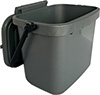
The kitchen caddy is only 5−litres and is designed to be kept on a kitchen work surface, windowsill or in a cupboard or under the sink.
However, if you don't want to use the small kitchen caddy, simply empty your food waste directly into the larger 23-litre food waste bin which you can keep outside. You could also use your own smaller container to keep food waste in the kitchen before transferring it to the outside bin.
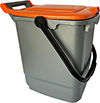
The outside food bin is not as large as a regular recycling or general waste bin. It is a 23-litre container, which only takes up about as much space as a pair of adult-size wellington boots.
If you live in flats then a 140-litre wheeled bin with an orange lid will be supplied to your bin store for you to empty your kitchen caddy contents into.
Will I be provided with liners for my kitchen caddy?
All households and flats will be provided with an initial roll of compostable liners, to help get you started. If you choose not to use liners once these run out, the food waste can be placed in your kitchen caddy loose, but it could help to keep it clean if you can line it with any of these:
- newspaper
- compostable liners from any supermarket
- kitchen roll, which can help soak up any liquids
While you can use plastic bags to line your kitchen caddy, we do not recommend this. We advise only using compostable liners.
The majority of the bags will be removed during the anaerobic digestion process, but avoiding plastic bags will drastically reduce the amount of single use plastics used in West Sussex, as well as reducing the amount of microplastics found in the end material.
Will the food in my new bin smell?
Your food waste will be collected every week. Moving the contents of the caddy to the external bin will also reduce the possibility of smells.
In addition, if you want to wrap odorous items like fish in newspaper, that can help prevent smells.
Please do not use plastic bags or cling film to wrap your food waste.
The kitchen caddies and external bins are also small enough to be easily cleaned with hot water and washing up liquid if needed.
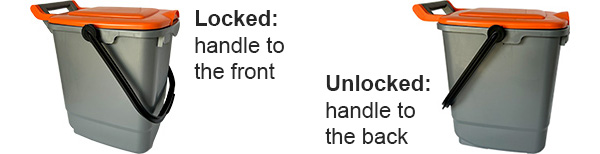
Keeping your food waste caddy and bin lid closed in the locked position (handle forwards or upright) will also help to contain any potential smells.
How do I avoid vermin or flies being attracted to the food waste bin?
Using your external lockable food recycling bin for any food waste and putting it out for collection every week, will help avoid smells and therefore should not attract foxes and vermin.
Maggots are fly larvae, usually the common housefly and the bluebottle. Flies are attracted to food and other general waste; they lay their eggs on this material; later the eggs hatch into maggots. If flies settle on your waste, they may lay eggs which can hatch out as maggots within 24 hours. Therefore, the frequency of general waste collections has very little impact on this process.
All your potentially 'smelly' food waste will be collected weekly, and any general waste left securely wrapped or tied in a bin should not attract any pests.
How does the lid lock work?
We are aware that some people have been having issues with the lid and handles of their new outdoor food waste caddies.
Your food waste caddies are lockable and are generally delivered in the locked position.
To unlock the caddy, simply move the handle from the front or upright position to the back of the caddy. Please ensure that the caddy is in the unlocked position prior to opening.
The caddies have two locking positions (handle upright or forward). If your caddy has an issue locking in the upright position then please present it with the handle forward when collections start.
If the lid is slightly warped when it is delivered to you, this is likely due to being transported and should settle.
However, if your caddy is completely broken please report it to us on help.aws@adur-worthing.gov.uk and we will replace it once we have completed deliveries of caddies to all households whose collections start in September.
How much is this new service costing?
The new food waste collection forms parts of your overall collection service, which is carried out by us as your local council. This forms part of our statutory duties. These are covered by your usual council tax payments. The government has provided us with extra funding to cover the costs of setting up the service, which includes funding for the purchase of trucks, staffing costs, and other costs such as communications work.
Preventing food waste
Of the food waste found in our bins, 70% could have been eaten at some point before being thrown away.
Of that, 41% is not used in time and 25% is binned because too much has been cooked.
Reducing the amount we throw away by only buying and cooking what we need, storing food properly and using our leftovers, is not only a win for the environment but could save the average family of four an estimated £80 per month.
For more information on reducing food waste please see:
See also on our website:

Need assistance with this service?
Get in touch:
Recycling, Refuse & Waste (general enquiries)

Problem with this page?
Page last updated: 01 October 2026