

Connected Communities Grant Fund
Introduction to the Connected Communities Grant Fund
In 2026, Adur & Worthing Councils agreed to streamline our grants process to make applications simpler and less time-consuming for community groups. This has resulted in the newly named 'Connected Communities Grant Fund', which is made up of four previous sources of grant funding - the Adur Community Grant, Community Transport Grant, Worthing Community Infrastructure Levy (CIL) Neighbourhood Fund and income from textile recycling in Adur.
This means voluntary, community and social enterprise groups (VCSE) will only have to apply once for council funding - freeing up time that would have been spent on administration for both groups and our officers.
What can the Connected Communities Grant Fund be used for?
Communities have the freedom and power to spend the money on a wide range of things, in consultation with the local residents. Local project proposals seeking support from this fund, can therefore cover a broad range of project types. Funding could support projects such as:
- Community facilities and buildings
- Open space, play and leisure facilities
- Accessibility improvements
- Environmental and biodiversity projects
- Heritage and cultural infrastructure
- Encourage community cohesion
- Delivering public art
There are some projects which we cannot fund:
- Projects that cannot demonstrate they will have a clear benefit to the residents or communities in the geographical area to which the application is made
- Groups that discriminate on the basis of race, religion, national origin, disability, age, or sexual orientation
- Retrospective funding for activities that have already taken place
- Projects which only benefit animals
- Political activities
- Projects which relate solely to religious purposes (unless it has a wider community benefit)
- One-off events (unless it can be demonstrated that there will be a lasting impact on the local community)
Who can apply for the Connected Communities Grant Fund?
Grants may be awarded to not-for-profit organisations, working for the benefit of Adur and Worthing. To apply, your group does not have to be a registered charity but you do need:
- A constitution or set of governing rules
- Accounts or records of expenditure
- To be able to sign a UK Subsidy Form (available in the 'timeline to apply' section below), which details the grants receivable by your group over a three-year period
- A bank account; or a partner organisation willing to hold the money for you
- To deliver the project/activity within the geographical areas where funding is available, within the district of Adur or the Borough of Worthing. Groups must be able to evidence the local need for a project in the area to which they are applying
- To have suitable and relevant policies (such as safeguarding or insurance) to run your project
- To be ready! You'll need to complete the project and have spent the money within twelve months of receiving the grant - therefore you should have all the necessary permissions in place to deliver your project
How will neighbourhoods be defined?
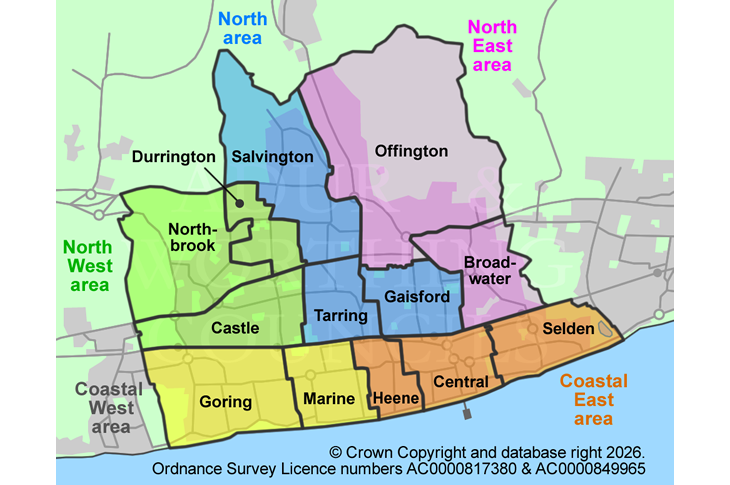
Following on from the success of the Worthing CIL Neighbourhood Fund, both Adur and Worthing will be split up into 'areas' which will have differing amounts of funding available each year - see what funding is available in 2026? (below).
In the absence of parishes and neighbourhood plans, which is the case in Worthing, the CIL Regulations allow the council to design its own bespoke definition of what constitutes a local neighbourhood area for the purpose of allocating the CIL Neighbourhood Fund. Since 2023, the CIL Neighbourhood funding is allocated based on 'CIL areas' (groupings of wards) where the development takes place.
The aggregated groups of wards which form the Worthing 'areas' are:
- Coastal East: Heene, Central and Selden
- Coastal West: Marine and Goring
- North West: Northbrook, Castle and Durrington
- North: Tarring, Gaisford and Salvington
- North East: Broadwater and Offington
Note that the Worthing areas exclude any area covered by the South Downs National Park Authority.
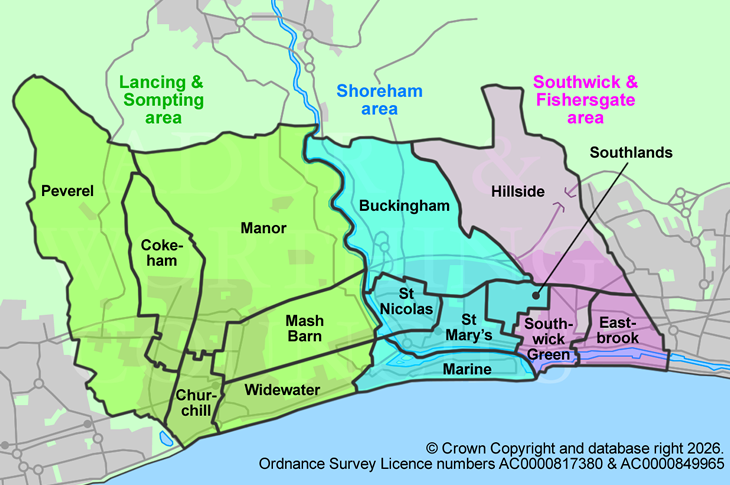
In order to align the same approach as for Worthing, the Adur 'areas' are set out below which clearly defined three separate geographical regions for groups to apply to depending on where their project is taking place:
- Lancing and Sompting
- Shoreham
- Southwick and Fishersgate
Note that the Adur areas exclude any area covered by the South Downs National Park Authority.
What funding is available?
Area and amount available:
- Worthing Coastal East - £39,873.27
- Worthing Coastal West - £20,730.94
- Worthing North - £12,845.89
- Worthing North East - £10,000.00
- Worthing North West - £0.00
- Adur: Lancing & Sompting - £12,664.00
- Adur: Shoreham - £12,664.00
- Adur: Southwick & Fishersgate - £12,664.00
The figures used for public communications will be rounded to the nearest £1,000.
The amount of money which is made available to groups in Worthing is dependent on the levels of CIL receipts being received by the council from liable developments, which have commenced work in a CIL area during the last financial year - for 2026 these are Coastal East, Coastal West and North. The funding for the North East area comes from previous Community Transport Grant funding for Worthing.
The amount of money which is available to groups in Adur is dependent on the level of income from textile recycling (to top up the council revenue funding that previously formed the Adur Community Grant). This funding is then split evenly between the three areas.
The Connected Communities Grant Fund is intended to support small, local projects. Bids will be considered on their merits, as follows:
- Project proposals can request a minimum of £1,000 and up to a maximum allocation of £5,000
- Project proposals that match this fund with other funding sources, will be encouraged - for example, the Connected Communities Grant Fund could be used as the match funding element to secure a larger funding award from other organisations, or in-kind support such as volunteer hours. The councils are keen to move towards a position of a 'last funder' whereby groups have secured additional funding and need a few thousand pounds extra in order to be able to deliver their project.
The Connected Communities Grant will be available to fund one off project costs. This means there will be no commitment by the council to meet ongoing costs (eg maintenance or revenue costs), beyond the initial funding award. However, the impact of the project should be lasting to the local community.
What types of projects are we looking for?
We want to continue supporting and celebrating the great work of the voluntary and community sector as we launch the Connected Communities Grant Fund programme. The council is interested in projects which meet the following criteria:
- Focus on young people - this could include:
- Providing services for children and young people
- Youth-led projects/activities
- Working to support young people in getting involved in activities and/or collaborating with other local residents/community groups
- Learning new skills
- Provide spaces for young people (including access to support services)
- Climate resilience - this could include:
- Projects which help our communities and local environment respond and adapt to the impacts of climate change
- Projects which involve climate and environmental action
- Projects which provide benefits to places that could be impacted by a changing climate
Applications should also include evidence of:
- Direct benefit to residents and/or the environment of the geographical area to which you are applying:
- Applicants should provide evidence of clear local need and direct benefits to the geographical area to which they are applying
- Provides evidence of a lasting impact on residents and/or the environment:
- The impact of the project should be felt by local residents and/or the environment beyond just the initial use of the funds
Timeline to apply
The timeline for applying to the Connected Communities Grant Fund for 2026 is set out below:
September 2026: A series of networking events will be held which community groups can attend. In these workshops we will share refreshed guidance on the fund, create opportunities for participants to network, share knowledge about the neighbourhood and develop project ideas.
- Tuesday 8th September: 3pm to 4:30pm at QEII Room, The Shoreham Centre, 2 Pond Road (workshop)
- Friday 11th September: 10am to 11:30am at Committee Room 2, Worthing Town Hall, Chapel Road (workshop)
- Monday 14th September: 6pm to 7:30pm at Eastbrook Community Centre, Fishersgate (workshop)
- Wednesday 16th September: 10am to 11:30am at Lancing Parish Hall, 96 South Street (drop-in)
- Thursday 24th September: 6pm to 7:30pm at Chichester Room, Field Place, Worthing (workshop)
- Click here to sign up to attend these events (on Eventbrite)
14th September to 25th October 2026: Groups are invited to complete and submit the application form below (note that you will need to have, or create, a Google account to access the form):
UK Subsidy Form:
 UK Subsidy Control Declaration form - to type into (305KB)
 UK Subsidy Control Declaration form - to hand write (84KB)
See also:
November and December 2026: Projects that meet the above outlined criteria will be sent through to an assessment panel - the panel will consist of council officers, elected Ward Members and specially invited community representatives who will go through the application forms submitted and evaluate/score each application based on the criteria set out above. The panel will then recommend which projects are to be allocated CIL funding. The assessment panel will complete an evaluation of each project proposed and provide feedback to each applicant.
January 2027: The assessment panel's recommendations are included in a report to the relevant cabinet member who will sign off on which bids are approved. All applicants will then be notified of whether they have been successful and will be given feedback on their project
More information is available in our guidance note for applicants:
- Connected Communities Grant Fund - guidance note 2026 (796KB)
- See also the FAQs in the section below
Any questions?
Adur & Worthing Councils have put together a document which contains some Frequently Asked Questions (FAQs) regarding the Connected Communities Grant Fund:
If you have any other questions please email:
Page last updated: 05 October 2026